Process SafetyProcess SafetyHAZIDHAZOPGuide WordsProcess Hazard AnalysisNodeDeviationAnimatedTechnical Safety Engineering Series
Technical Safety Engineering, Part 5: HAZID and HAZOP
How hazards are found on paper before a plant is built: the difference between HAZID and HAZOP, the history of HAZOP, the three questions, guide words and deviations, a worked reactor example with a worksheet you can build, how to choose nodes, who is in the team and what each person does, ground rules, and when in a project each study is held. Four interactive animations.
SM
Sumit Mathur
17 min read
Once a design exists on paper, there is still time to find what is wrong with it cheaply. HAZID and HAZOP are two structured ways to do this. They are team studies: people from different disciplines look at the design together and ask, in an organised way, “what could go wrong?”.
This is Part 5 of a 7-part series on technical safety engineering. Part 1 introduced hazard and risk. Here we see how the hazards are found. Part 6 shows how the findings are turned into numbers and safeguards.
A process hazard analysis (PHA) is an assessment of all the potential hazards of a process. It looks at anything that could affect the process:
equipment failures,
instrument failures or bad calibration,
loss of utilities,
human error.
Both the frequency and the severity of what can happen must be considered. The basic message is that things can and do go wrong.
2. HAZID
HAZID (hazard identification) is a qualitative assessment of hazards, made during project design, construction, installation and decommissioning. It is a brainstorm by a multidisciplinary team, and its findings are handled by the designers later.
It is held early: in the late select stage, once layout drawings and process flow diagrams exist. For an existing plant it updates the hazard register and examines proposed changes.
It uses primary and secondary guide words to look for deviations. A typical set:
Loss of containment: rupture, puncture, gas cloud, liquid pool,
Fire: jet fire, pool fire, flash fire, thermal radiation,
Ignition sources: electrical, static, hot work, vehicles,
Human factors: inadequate training, personnel error, disease.
Typical inputs: general plant layout, area layouts (process, utility, storage, flare and blowdown), and flow diagrams.
A HAZID worksheet has the columns system, sub-system, hazard, consequence, severity, safeguards, recommendations and responsibilities. For example, in a tank farm: lightning strikes a naphtha tank → tank explosion, severity major → safeguard: lightning protection system → recommendation: for floating-roof tanks, make the fire fighting philosophy specific (rim seal or full surface).
HAZID or HAZOP?
HAZID
HAZOP
What it finds
The inherent hazards of a plant: location, activities, amounts of substances, hazardous properties, external events
Deviations from the design intention in a process section
Guide words
A wide range of hazards
Standard words applied to process parameters
Unit studied
The facility or activity
A node (part of the process)
Result used for
Design improvements
Adding safeguards
When
Early. It is the starting point for the other studies
When the design is firm (P&IDs available)
3. HAZOP
A short history
HAZOP began in the Heavy Organic Chemicals Division of ICI in the UK. It examined designs with a critical, structured technique. It was not widely used until the Flixborough disaster (1974), after which it became one of the most used risk-management methods in the chemical industry. If a thorough HAZOP had been done, that disaster could have been avoided. Today it is used in many industries, including food, water, pharmaceutical and general industrial safety.
What the name means
Hazard: any operation or action that could possibly cause a catastrophic release of toxic, flammable or explosive chemicals, leading to fire, explosion or toxic release.
Operability: any operation or action inside the design envelope that hurts profitability, for example shutdown or off-spec product.
HAZOP is a qualitative analysis that finds potential hazards and operability problems caused by deviations from the design intention.
Its objectives
Find, on paper during design, the scenarios that could lead to major safety or operability consequences.
Make sure the probabilities and consequences of major incidents are eliminated or reduced to an acceptable level.
Serve as a training exercise for operators and engineers.
The three questions
Every HAZOP discussion is built on three questions:
What could go wrong?
Why?
What could we do about it?
The procedure
The HAZOP review, step by step
Step 1 of 9
Take a node
Start with the first part of the process, the node, for example the cooling circuit of the reactor.
Example
Node 1: reactor and cooling coils.
What could go wrong?
Why?
What could we do about it?
Every HAZOP node follows the same loop. The first pass through a node is to make sure everyone understands what happens. The second pass is where the deviations are examined. Press play, or choose a step.
In words:
Take the first relevant parameter (flow, temperature, pressure, level, composition).
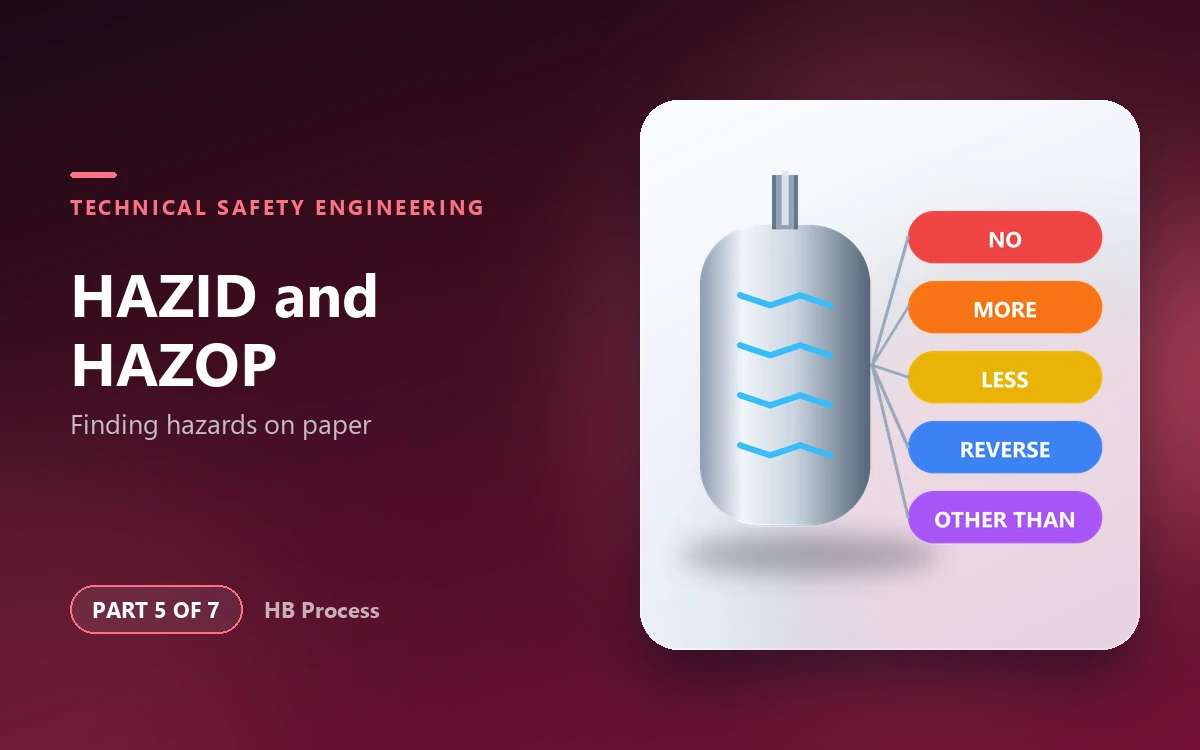
Apply the first guide word (no, more, less, reverse, as well as, other than).
Together they form the deviation.
Brainstorm the credible causes.
Consider the consequences.
If a consequence is dangerous, assess the safeguards that exist.
If they are not enough, agree on an action.
Go on until the node is complete.
When all nodes are done, the drawings are “yellowed off” (each line and item that was reviewed is coloured) and notes are made on them.
Walk through each node twice. The first pass is to make sure everyone understands what happens. The second pass is where the deviations are examined.
A worked example: a cooled reactor
A reactor makes a polymer. The reaction gives off heat (it is exothermic), so a cooling system with water coils removes the heat. A temperature controller (TC) uses a thermocouple to set the cooling water flow with a valve. If cooling is lost, the temperature rises, the reaction speeds up, and a runaway reaction could push the pressure above the bursting pressure of the reactor.
Build your own worksheet by trying the guide words:
A HAZOP worksheet, built from guide words
Flow + No =
No cooling water flow
Why? (causes)
Cooling water supply fails
Control valve fails closed
Coil is blocked
What could go wrong? (consequence)
Reactor temperature rises, the reaction speeds up, and a runaway can push the pressure above the burst pressure of the reactor.
Safeguards that exist
Temperature controller
High-temperature alarm
What could we do? (action)
Add an independent high-temperature trip that stops the monomer feed. Check that the relief valve covers a runaway.
Rows in your worksheet
0
Combinations in this example
9 of 18
The study team takes one parameter (flow, temperature, pressure) and combines it with a guide word (no, more, less, reverse, as well as, other than) to make a deviation. For each deviation it asks three questions: What could go wrong? Why? What could we do about it? The example is a reactor cooled by water coils. Pick a combination, read the answer, and add it to your worksheet.
Notice how each guide word leads to a different deviation, and how some of them (reverse flow, “as well as”) lead to environmental and maintenance problems, not only to the runaway.
4. Nodes
A node is a section of the process (a group of lines and equipment) that:
shares the same design intention (one process operation),
involves a critical parameter change,
contains an active component that can cause deviations (a pump, a valve, a controller),
or holds a significant amount of hazardous material (a tank).
How to choose nodes:
Start from the main process flow on the PFD. Nodes can be the process lines between the main vessels.
In a continuous plant, go from upstream to downstream.
Choose sections of common pressure, temperature and flow.
End nodes at physical boundaries.
Number and mark up the nodes.
Put the minor equipment between main vessels in the same node.
Treat services (utilities) separately and last.
Put control loops with the equipment they affect most.
Do not forget small branches.
Categories: process nodes (what could happen inside the node), a global node (initiating events that could affect the whole process, such as loss of power), and super nodes (combinations of lines and major vessels, used to speed up a study).
Other points:
Parallel trains may be studied separately, or one train in full and the next “by difference”. But beware: copying the first train’s analysis is a problem if the piping or equipment differs.
Use a separate node for each mode of operation: normal, reduced throughput, start-up, shutdown, emergency shutdown, commissioning and special modes.
For batch plants, a node can be a stage or a phase of the operation.
Size: big enough to save time, small enough to capture every hazard. Do not leave out a drawing because it seems to have “no hazard”, is similar to another, or is “just services”.
Choosing the nodes for a HAZOP
Fuel tank
Line
Pump P1
Line
Reactor
Line
Hydrocracker
Number of nodes
1
Workshop time
about 4 h
Hazards likely missed
75 %
Nodes mixing too many intentions
1
One node holds storage, transfer and reaction together. The team will not look closely enough at any of them. Split it.
A node is a part of the process with one design intention, for example moving fuel with a pump. Click the gaps to cut the line into nodes. A node should be big enough to save time and small enough that the team can see every hazard. Good nodes end at physical boundaries such as a vessel, and keep a pump or control loop with the equipment it affects. The time and missed-hazard figures are only an illustration of the trade-off.
5. The HAZOP team
A HAZOP needs a team with the right knowledge. The core team is present at all sessions:
Plans and prepares the study, chairs the meetings, makes sure the scope is covered, controls the discussion, uses guide words to trigger ideas, and issues the report
Secretary
Records every hazard with its safeguards and actions, writes the minutes, confirms that the team agrees with what is written
Process engineer
Explains how the process works, the design intention, the utilities, and judges whether safeguards are adequate
Design engineer
Gives project background and vendor package details, and quickly judges the cost, schedule and technical effect of a change. A vendor package without its diagrams cannot be studied
Instrument engineer
Describes the control philosophy, interlocks, alarms, shutdowns, testing needs and cause and effect charts
Operations expert
Represents the final users, brings knowledge of past incidents and changes, and keeps standards
Ground rules for the workshop
Start on time, and everyone contributes.
Do not design the solution in the meeting. Engineers like to solve problems, and the result is a time blowout. If a solution is obvious and agreed, record it. If problem solving starts, put the brakes on.
Present your views, but do not argue for them. Listen to others. Do not change your view just to avoid conflict.
Everyone concentrates on one location in the process. Visit the equipment when needed.
Taking notes
Only the scribe writes, and only what the leader directs.
Use complete sentences in the final version.
Make each recommendation clear and complete with its three W’s: what, where and why.
Use the full tag number (for example 12PSV251). If there is no tag number, describe the equipment well.
6. When is a HAZOP held?
Hold it when the design is fairly firm: the main drawings exist and changes can still be made without a major cost. If the data and drawings are incomplete, either wait, or go ahead and accept longer sessions and a large number of recommendations.
When is a HAZOP done in a project?
Front-end design
Study. Main HAZOP at the end of the front-end engineering design.
Focus. Assure the safety of the design as it stands. The design is firm enough but still cheap to change.
Needs. Piping and instrument diagrams, cause and effect charts, equipment data.
A HAZOP is held when the design is firm enough to study but still cheap to change. Held too early, there is nothing to review. Held too late, every recommendation is expensive. Click a stage to see what is reviewed. The cost curve shows only the idea: the later a change, the more it costs. The numbers are illustrative.
Coarse HAZOP: early, on the process flow scheme, to make the plant inherently safer.
Main HAZOP: at the end of the front-end design, to assure the safety of the design.
Final HAZOP: at the end of detailed design, to focus on changes and missed items.
Mini-HAZOP: for a proposed change or a vendor package.
Revalidation HAZOP: for an existing plant, normally every 5 years or after a major change. It brings in plant personnel, passes knowledge on, and raises awareness. Challenges include people who are not available and information that is missing.
Planning
The leader prepares terms of reference (TOR): team, scope, areas included and excluded, focus areas, process boundaries, equipment, utilities, the risk matrix to be used, a list of scenarios that are not credible, modes of operation, external events considered, schedule and deliverables, report distribution and reference documents. A missing or poor TOR is a common source of trouble. The design should be frozen in good time before the HAZOP.
7. Common mistakes
Holding the HAZOP on an unfrozen design, so the findings are out of date at once.
Skipping a drawing because it looks “just services” or “like the other train”.
Nodes that are too large (hazards missed) or too small (time wasted).
Designing in the meeting, instead of recording an action.
Missing key people: no operations expert, or no vendor drawings for a package.
Recommendations without what, where and why, or without an owner.
Summary
HAZID looks at the facility for hazards early. HAZOP looks at a process node for deviations from the design intent.
HAZOP asks three questions: what could go wrong, why, and what could we do about it.
The method combines a parameter and a guide word to form a deviation, then lists causes, consequences, safeguards and actions.
Good nodes have one design intention and end at a physical boundary.
The team brings process, design, instrument and operations knowledge. The leader controls the discussion and the scribe records.
Hold HAZOPs when the design is firm but still cheap to change, and revalidate about every five years.
Part 6 shows how the HAZOP findings are turned into safety functions and how many protection layers are enough.