Process SafetyProcess SafetyFireExplosionFlammable RangeFlash PointHazardous Area ClassificationZone 0Gas GroupAnimatedTechnical Safety Engineering Series
Technical Safety Engineering, Part 2: Fire, Explosion and Hazardous Area Classification
The fire triangle, the five kinds of fire (flash, pool, jet, fireball and solid), the classes of fire, the flammable range with oxygen and spark, flash point and the classes of petroleum liquids, and how hazardous areas are divided into Zone 0, 1 and 2 with gas groups and temperature classes. Five interactive animations and real photographs.
SM
Sumit Mathur
15 min read
Almost every major plant disaster involves a flammable material that escaped and found something to ignite it. To prevent fires and explosions, you first need to know exactly what it takes for a fire to start, what kinds of fire there are, and how engineers decide where electrical equipment can be placed safely.
This is Part 2 of a 7-part series on technical safety engineering. Part 1 covered safety in design and risk. Here we deal with fire, explosion and hazardous area classification.
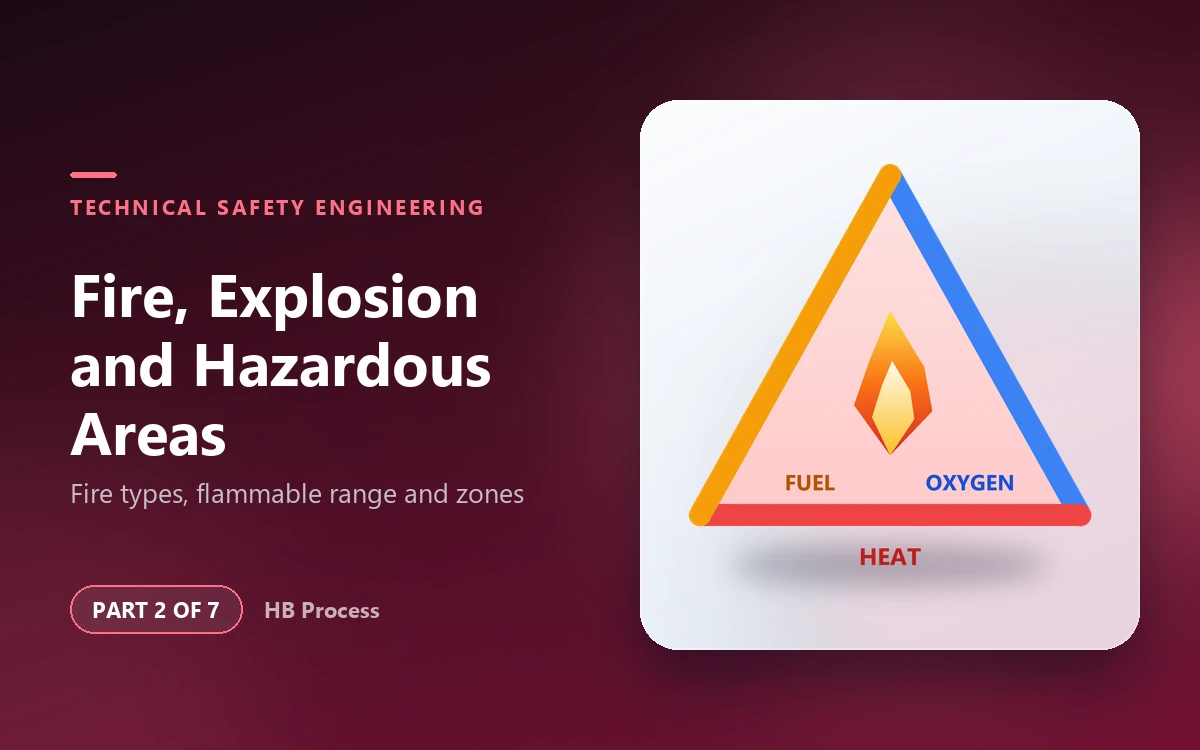
Take away one, and there is no fire. (Inside a flame, a fourth element, the chemical chain reaction, also matters, and some extinguishing agents work by breaking it.)
The best way to prevent a fire or a flammable-vapour explosion, inside or outside piping and equipment, is to avoid creating a flammable mixture.
Inside process equipment, control the fuel side and the oxygen side of the triangle (for example by keeping air out, or by purging with nitrogen).
Outside, oxygen is always present in the air. So we must stop the fuel from escaping into the surroundings.
But equipment and procedures do fail. A flammable atmosphere may appear anyway. So we must also work to remove ignition sources in any place where a flammable atmosphere could form.
This last idea is the basis of hazardous area classification, later in this part.
2. Fire or explosion?
The difference is how the fuel and air are mixed when they are ignited.
Fire: fuel and air are separate. The fuel burns where it meets the air. The flame spreads slowly.
Explosion: the fuel is already mixed with air (a gas or vapour cloud, or a dust cloud) before ignition. The whole mixture burns at once, and the sudden expansion makes a pressure wave.
3. Five kinds of fire
How the fuel is released decides the kind of fire. Pick one below.
Five ways a fire can burn
Jet fire
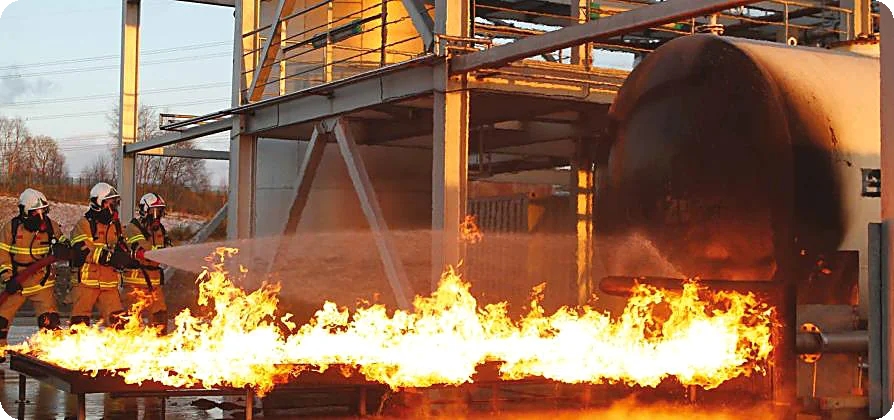
What it is. A pressurised gas or liquid leaks out at speed and burns as a long torch. The high speed of the fuel gives the flame direction.
How long. As long as the pressure and inventory last
The danger. Very high heat where the flame touches steel. A jet can cut through a vessel wall or heat a neighbouring vessel in minutes.
Defence. Isolate quickly, depressure, keep equipment out of the line of fire, fireproofing, fixed water spray.
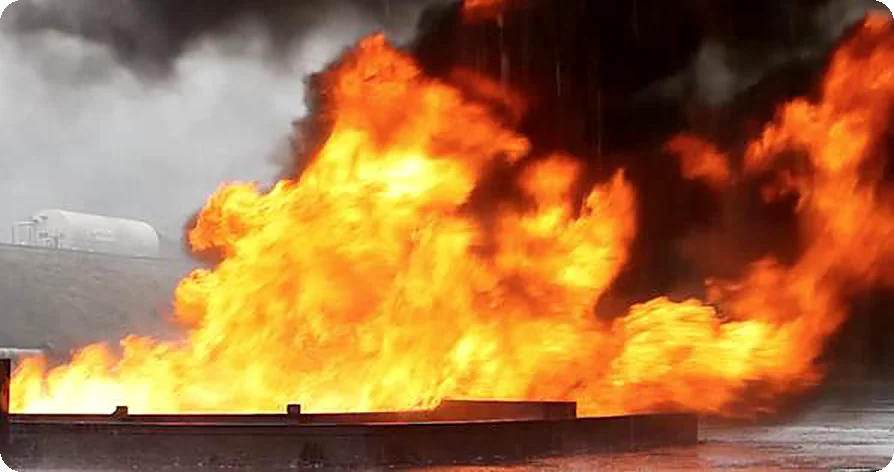
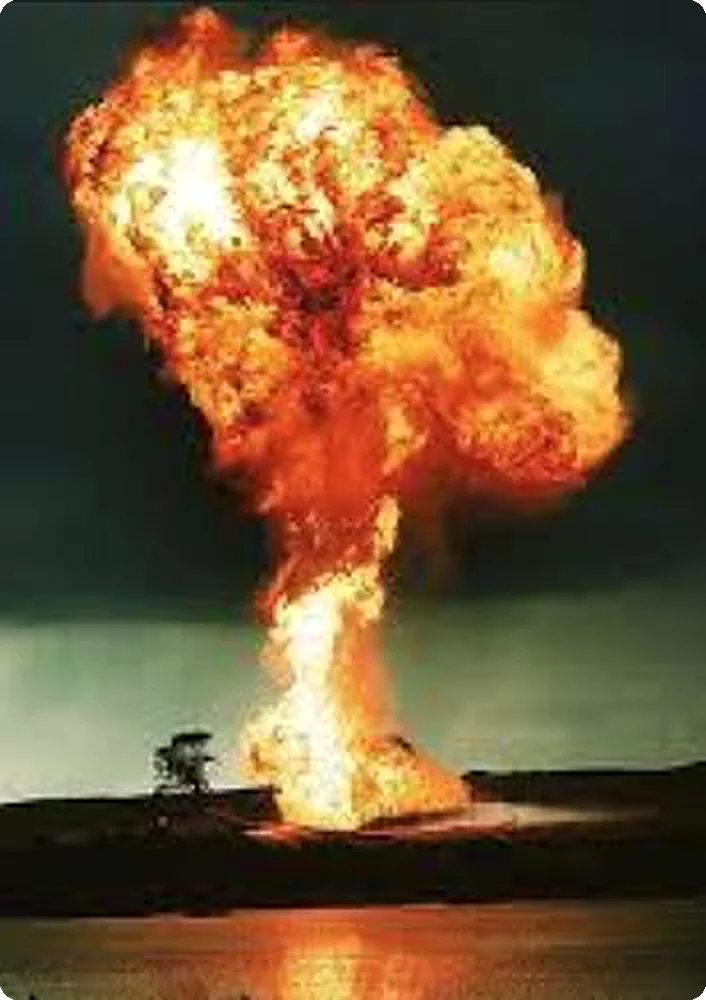
The way fuel is released decides the kind of fire, and the kind of fire decides how to protect against it. Pick a type to see how it behaves and how to defend against it. The photos are real fires.
A jet fire is a torch from a pressurised leak. A pool fire burns above a spilled liquid. A fireball is a short and very intense burst.
Fire
Source
Main danger
Flash fire
A vapour cloud ignites
Brief fire through the whole cloud. Anyone in it is engulfed
Pool fire
A spilled liquid burns
Large radiant heat and smoke, heats equipment in the pool area
Jet fire
A pressurised leak burns as a torch
Very high heat on the target, can quickly weaken steel
Fireball
A large release ignites at once (BLEVE)
Short, intense radiant heat, with a blast
Solid fire
Ordinary solids burn
Spread and smoke, common in buildings
A BLEVE (boiling-liquid expanding-vapour explosion) happens when a liquid stored above its normal boiling point is suddenly depressurised, for example when a pressurised LPG vessel ruptures in a fire. A near-instant change from liquid to vapour releases a huge amount of energy. The remedy is to keep the vessel from heating: fireproofing, water spray, relief valve and, where suitable, depressuring (see our article on Depressurization).
4. Classes of fire
The class of fire decides which extinguishing agent is safe to use (the agents are covered in Part 3).
Class
What burns
A
Ordinary solids: wood, paper, cloth, rubbish
B
Flammable liquids: petrol, oil, paint
C (electrical)
Live electrical equipment
D
Combustible metals and metal alloys
K
Cooking oils and fats
5. The flammable range
Combustion occurs only if the mixture of fuel (gas or vapour) and air is inside certain limits:
the lower flammable limit (LFL), also called the lower explosive limit (LEL): below this, the mixture is too lean (not enough fuel),
the upper flammable limit (UFL): above this, the mixture is too rich (not enough air).
Between them is the flammable range. A wide range is more dangerous: hydrogen burns from about 4 % to 75 % in air, but methane only from about 5 % to 15 %.
There is also a minimum oxygen concentration below which the mixture cannot burn, whatever the fuel level. This is why a vessel can be made safe by purging it with nitrogen (inerting).
The flammable range
The mixture is
Flammable mixture
Flammable range
5 – 15 %
Oxygen needed above
12 %
With a spark
It would burn
To make this safe, take away one of the three sides of the fire triangle: remove the fuel (keep the mixture under the LFL), remove the oxygen (inert with nitrogen) or remove the spark.
A gas and air mixture burns only if the fuel is between its lower flammable limit (LFL) and its upper flammable limit (UFL), and there is enough oxygen. Below the range it is too lean and above it is too rich. Move the fuel concentration across the range, switch the spark on, and then lower the oxygen. A wide range, like hydrogen, is more dangerous. Values are typical, in % by volume in air.
Things to try:
Choose hydrogen and see how much of the scale is flammable.
Move the fuel level down into the “too lean” zone and switch on the spark: nothing happens.
Put the mixture inside the range, switch the spark on, and then lower the oxygen. At some point the fire goes out.
Remember the leak: a gas cloud that is too rich near the source becomes flammable as the air mixes in and dilutes it.
6. Flash point and liquid classes
A liquid does not burn. Its vapour does. The flash point is the lowest temperature at which a liquid gives off enough vapour to form a flammable mixture above its surface. Below the flash point, the vapour is too thin.
Liquids are grouped by closed-cup flash point.
In India (OISD): Class A (the most hazardous) has a flash point below 23 °C, Class B 23 – 65 °C, Class C 65 – 93 °C, and above that the liquid is not classified. Liquefied gases such as LPG are a separate group.
In the NFPA 30 code, flammable liquids are Class I (IA, IB, IC) and combustible liquids are Class II, IIIA and IIIB.
Flash point: when does a liquid give off enough vapour?
Liquid is
above its flash point
Margin
12 °C
Indian oil industry class (OISD)
Class A
NFPA 30 class
Class IB
Typical limits (closed cup): OISD Class A below 23 °C, Class B 23 – 65 °C, Class C 65 – 93 °C, above that excluded. NFPA 30 splits the flammable group (Class I) into IA, IB and IC and the combustible group into II, IIIA and IIIB. Liquefied gases such as LPG are not in either list: they form their own group because they boil far below ambient temperature.
Even a combustible liquid behaves as a flammable one when it is stored or handled above its flash point (hot oil, for example).
The flash point is the lowest liquid temperature at which enough vapour forms above the liquid to ignite near a flame. Below it, the vapour is too thin to burn. Above it, the liquid acts like a flammable gas source. Liquids are grouped into classes from their closed-cup flash point. Pick a liquid or slide the values, then warm the liquid up.
Class A and B storage tanks carry fixed fire protection once they are above certain sizes (see Part 3). The classes also drive spacing between tanks and the rules for handling the liquid.
7. Hazardous area classification (HAC)
If a flammable atmosphere may be present, then ordinary electrical equipment (a motor, a lamp, a switch) could be the spark that ignites it. Hazardous area classification is the method that analyses and classifies the places where an explosive atmosphere may occur. It shows:
where an explosive atmosphere may occur,
how likely it is,
which materials cause it.
The result is a set of drawings and a memorandum that lets the right equipment be chosen and installed.
Every area where flammable gas, vapour or mist can appear in a dangerous amount is classified, so the right equipment can be chosen.
Zones
The areas are divided into three zones by the probability of a flammable atmosphere being present.
Zone 0: an explosive atmosphere is present continuously, or for long periods, or frequently. Example: inside the vapour space of a closed tank.
Zone 1: an explosive atmosphere is likely to occur occasionally in normal operation. Typical Zone 1 places include: the imperfect seal of a floating roof tank, inadequately ventilated pump rooms, API separators, oily sewers and sumps, LPG cylinder filling and evacuation areas, and the area right next to vents and filling hatches.
Zone 2: an explosive atmosphere is not likely in normal operation, and if it does occur, it lasts only a short time. For example, a system that normally keeps the fluid in closed pipes and where a leak occurs only on an abnormal failure, such as a gasket or packing failure, and the area is well ventilated.
How often a source releases (continuously, in normal operation, or only on failure) gives the zone. Ventilation changes how far the zone extends.
Where is the explosive atmosphere? Zone 0, 1 and 2
Release grade
Primary
Zone 1 reaches
1.5 m
Zone 2 reaches
3.0 m
Zone 0
none
Vapour is released regularly, in normal operation (for example when the tank is filled). The area close to the opening is Zone 1.
Anything inside a zone, such as a motor, a lamp or a phone, must be built so that it cannot ignite the gas. Zone 0 needs the highest protection and Zone 2 the least.
A plan view (looking down) of a release point. Zones tell how likely a flammable atmosphere is: Zone 0 is present continuously or for long periods, Zone 1 occasionally in normal operation, and Zone 2 not normally, and then only briefly. How often a source releases decides the zone type. Ventilation changes how far the zone reaches. The distances here are only for illustration. Real distances come from the codes (such as API 505, IP 15 and IS 5572) and the properties of the fluid.
Gas groups and temperature class
Equipment for hazardous areas is marked for the gas it can be used with.
Gas group. Group II gases are split into IIA, IIB and IIC, in increasing order of how easily they are ignited (how little spark energy is needed).
IIA: for example acetone, ammonia, ethyl alcohol, gasoline, propane.
IIB: for example ethylene.
IIC: for example acetylene and hydrogen.
Equipment for a higher group (IIC) can be used with the lower groups, but not the reverse.
Temperature class. The temperature class says the maximum surface temperature the equipment can reach. It must always be lower than the temperature at which the gas or vapour in air ignites by itself.
Class
Maximum surface temperature
T1
450 °C
T2
300 °C
T3
200 °C
T4
135 °C
T5
100 °C
T6
85 °C
Is this equipment allowed in this gas?
Hydrogen
Gas group IIC · temperature class T1 · ignites by itself at about 560 °C
Equipment
Group IIB · T3 · surface never above 200 °C
Not allowed: group IIB equipment is not safe in group IIC gas. A group IIC device covers IIA and IIB too, but not the other way round.
Electrical equipment in a hazardous area is marked with a gas group and a temperature class. The gas group tells how easily a spark ignites the gas (IIA is the easiest to control, IIC the hardest). The temperature class is the hottest surface the equipment can reach, and it must stay below the temperature at which the gas ignites by itself. Pick a gas and a piece of equipment to test it.
How the classification is prepared
First, a hazardous area source list:
Enter the flash point of the liquid.
Enter the mole percent of the flammable in the stream.
Enter the LFL and UFL from the fluid properties.
Decide whether the equipment is flammable.
Assign the zone type, gas group and temperature class.
Then, the classification layout drawing:
Identify the equipment that creates hazardous zones.
Give each one a radius or radii from the applicable code.
Classify the zones as Zone 0, 1 or 2 from the grade of release.
Mark the zone on sectional drawings if needed.
Codes commonly used include API 505, the Energy Institute model code (EI 15), the IEC 60079-10 standard, IS 5572 and OISD 113. The inputs come from the process team (safety data sheets, equipment list, heat and mass balance) and the piping team (equipment layout and plot plan).
8. Common mistakes
Treating a combustible liquid as safe. Above its flash point it behaves as a flammable one.
Forgetting mists and sprays, which can burn below the flash point.
Choosing equipment by gas group only, and forgetting the temperature class (or the other way round).
Giving every area the same zone, instead of using the grade of release and the ventilation.
Not updating the classification drawing after the layout changes.
Summary
A fire needs fuel, oxygen and heat. Prevent the mixture first, and remove ignition sources where a mixture could appear.
A fire burns where fuel meets air. An explosion burns a mixture that was already premixed.
There are five kinds of fire: flash, pool, jet, fireball and solid. How the fuel is released decides the kind.
Gas burns only inside its flammable range and with enough oxygen.
Flash point decides the liquid class.
Hazardous areas are Zone 0, 1 and 2. Equipment must match the gas group and temperature class.
Part 3 turns to the fire itself: how to fight it with fire water, sprinklers, spray, foam and gas.